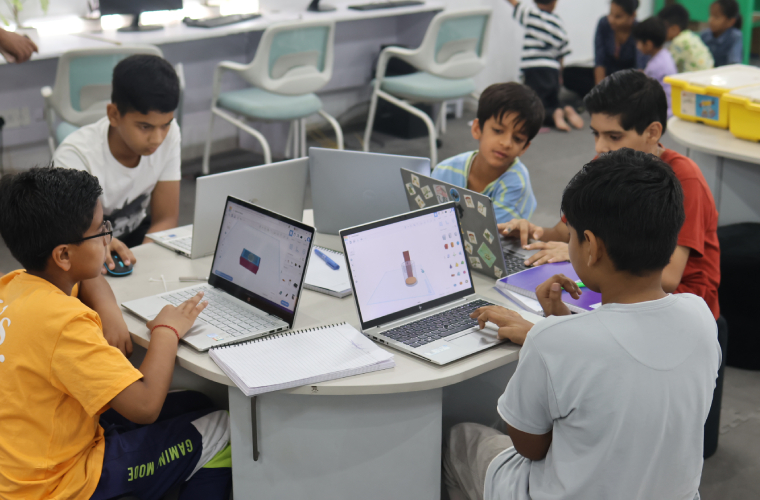
India is changing fast. The jobs waiting for today's 10-year-olds barely exist yet. Artificial intelligence, robotics, sustainable design these fields do not just need people who can solve equations. They need people who can think, create, and connect ideas across very different areas.
That is exactly the gap that STEAM education in India is trying to fill.
You have probably heard the term. Maybe your child's school mentioned it, or you came across it while looking at coding programs. But what does STEAM actually mean in practice? How is it different from regular schooling? And is India really moving in this direction?
This guide answers all of that, plainly and honestly.
What Is STEAM Education?
STEAM stands for Science, Technology, Engineering, Arts, and Mathematics. It is not a separate subject. It is a way of teaching where these five areas are woven together instead of taught in isolation.
Think about a child building a small bridge using cardboard. They are applying basic physics, figuring out how to hold it together, measuring pieces, making the design neat, and often using a tablet to research ideas. That is STEAM learning in one simple activity.
In a traditional classroom, science class teaches science. Math class teaches math. They rarely talk to each other. A student can pass both without ever understanding how they connect in real life. STEAM deliberately breaks that wall.
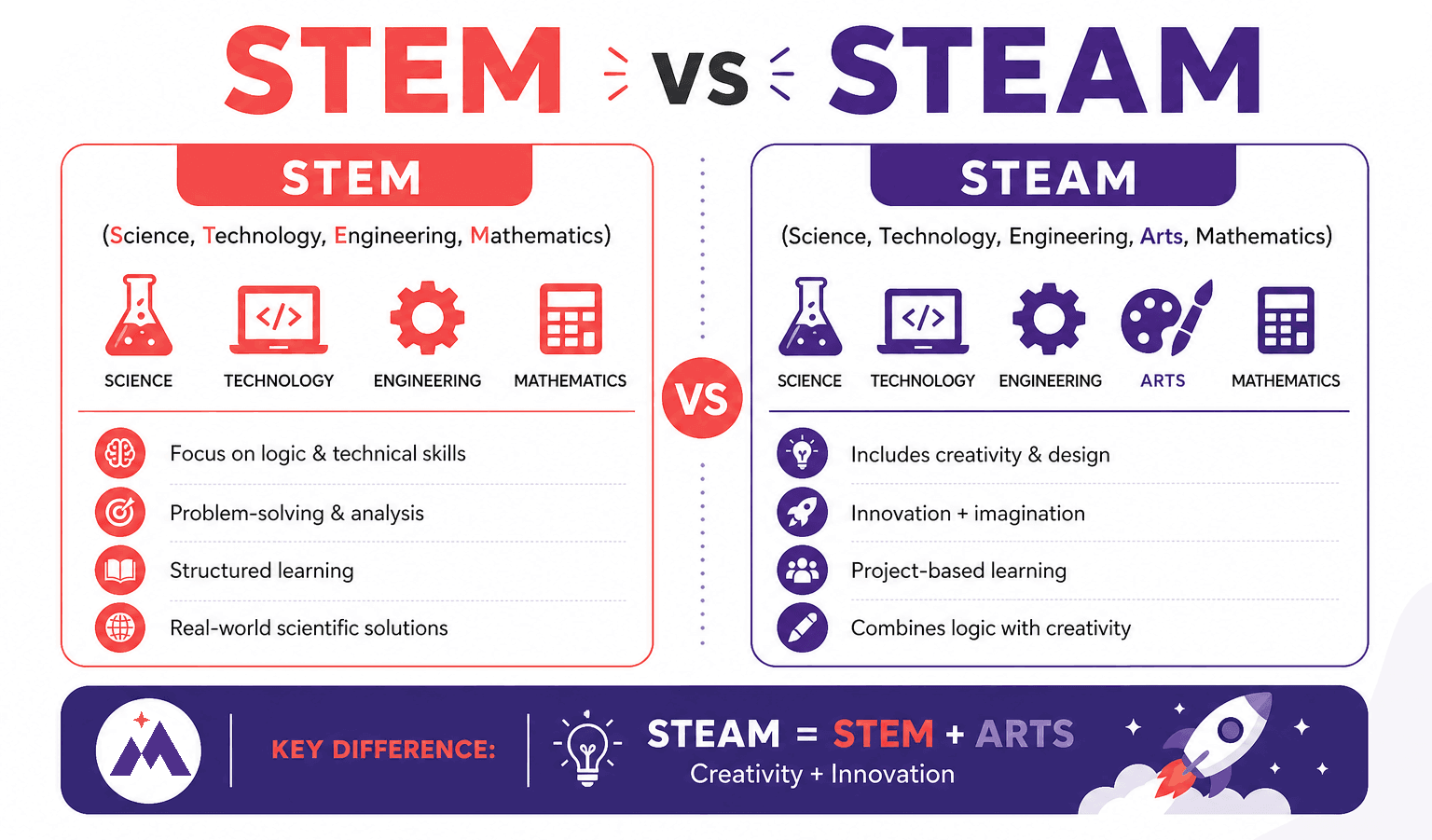
STEAM vs STEM: What Is the Difference?
The only difference is the "A" Arts. Some people think this makes STEAM softer. That is a misunderstanding. The arts in STEAM bring in design thinking, creativity, and the ability to see problems from a human angle.
A software engineer who cannot make a product feel intuitive, or a scientist who cannot explain their work clearly these are real gaps. The arts component teaches students to think about the people behind the problems, not just the numbers.
Why STEAM Education in India Is More Important Than Ever
India has a long tradition of valuing education. But there is a hard truth that is becoming impossible to ignore.
According to the India Unemployment Report 2024, nearly 65.7% of educated youth are unemployed, a figure that has nearly doubled since 2000. Three out of four Indian youth lack basic ICT skills like using spreadsheet formulas or writing simple computer programs.
These are not lazy young people. They studied hard, passed exams, and still came out without the skills workplaces actually need. The reason is a curriculum that has stayed mostly theoretical for decades. Students memorise content to pass tests. They rarely get to apply what they learned to real problems.
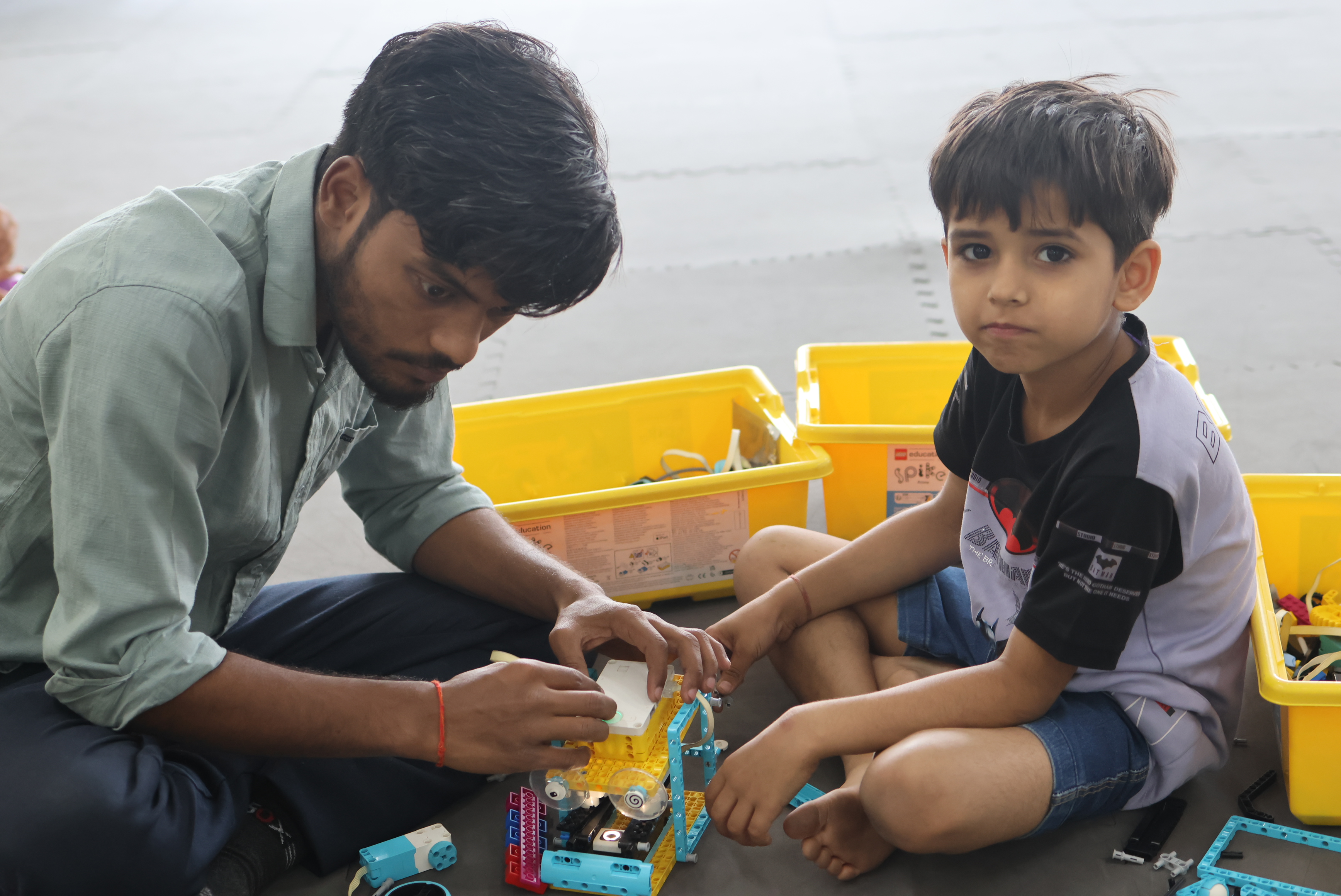
STEAM education is a direct response to this gap. When a student builds a working robot, writes code that controls it, and designs a chassis that is both strong and efficient, they are doing something no multiple choice test can replicate. They are learning how to learn.
What the Indian Government Is Doing About It
The shift toward STEAM education in India is not just happening in private schools. The government has been pushing this direction seriously, especially after 2020.
National Education Policy 2020
The National Education Policy (NEP) 2020 is one of the most significant overhauls of India's education system in decades. Its core idea is that STEAM thinking should be a universal foundation for every learner, not a specialist track reserved for science students.
NEP 2020 pushes for experiential learning, project-based work, and less pressure from high-stakes exams. It encourages schools to let students explore multiple subjects together rather than forcing early specialisation. This is, in essence, a national endorsement of STEAM thinking.
Atal Tinkering Labs
The Atal Innovation Mission, launched by NITI Aayog in 2016, runs the Atal Tinkering Labs program. More than 10,000 of these labs are already set up in schools across the country, equipped with robotics kits, 3D printers, AI modules, and microcontrollers.
So far, over 1.1 crore students have created more than 16 lakh projects through this initiative. The government has also announced plans to expand this to 50,000 labs, making it one of the largest hands-on learning programs in the world.
PM SHRI Schools
The PM Schools for Rising India scheme is upgrading more than 14,500 government schools to implement NEP 2020 fully. These schools get smart classrooms, STEM labs, and Atal Tinkering Labs as part of their upgrade. As of now, 12,084 schools across 32 states and union territories have been selected.
Benefits of STEAM Education for Students
The case for STEAM does not rest only on policy. There are direct, practical benefits that show up in how children grow.
Stronger problem solving. Breaking a big challenge into smaller parts and testing solutions is a skill that gets stronger with practice and carries into every area of life.
Better collaboration. Most STEAM projects are done in groups. Students learn to share ideas, disagree respectfully, divide work, and move toward a shared goal — skills that employers consistently rank as the most important.
Deeper curiosity. Children who learn through doing naturally ask more questions. The habit of asking "what if" is one of the most powerful things a person can develop.
Higher engagement. A child who dreaded science exams often comes alive when given a real project. Engagement is not a small thing. It is the difference between a student who stays curious and one who quietly gives up.
Future readiness. The World Economic Forum lists critical thinking, creativity, and complex problem solving among the top skills future jobs will require. STEAM builds all of these as the core of how learning happens.
At Mittyverse, we have seen these benefits show up firsthand. Our students as young as 6 years old build working robots, write their first lines of code, and walk away from every session asking questions their parents cannot always answer and that is exactly the point. Our Explorer, Creator, and Innovator programs are all structured around this same STEAM thinking, where every session is hands-on, project-based, and connected to real skills.
Challenges That STEAM Education Still Faces in India
It would not be honest to skip the difficulties.
The urban and rural gap is real. Schools in Tier 1 cities are adopting STEAM labs at a growing pace. But across rural areas, things look very different. According to UDISE+ 2024 to 2025, only 63.5% of Indian schools have internet access and just 64.7% have functional computers. Without reliable electricity and basic infrastructure, even simple hands-on activities are hard to run.
Teacher training is another gap. STEAM teaching needs educators who are comfortable with open-ended exploration rather than delivering fixed lessons. Shifting that takes time and genuine support, not just one-day workshops.
Board exam pressure also pulls things back. Even schools that want to embrace STEAM thinking feel the weight of Class 10 and 12 results. Until assessment systems change alongside teaching, this tension will stay.
This is why at Mittyverse we keep our programs accessible both online and offline, so that quality STEAM learning is not limited to one city or one type of school. We also work directly with schools through our STEAM Lab Setup service, helping institutions turn policy into actual practice for students.