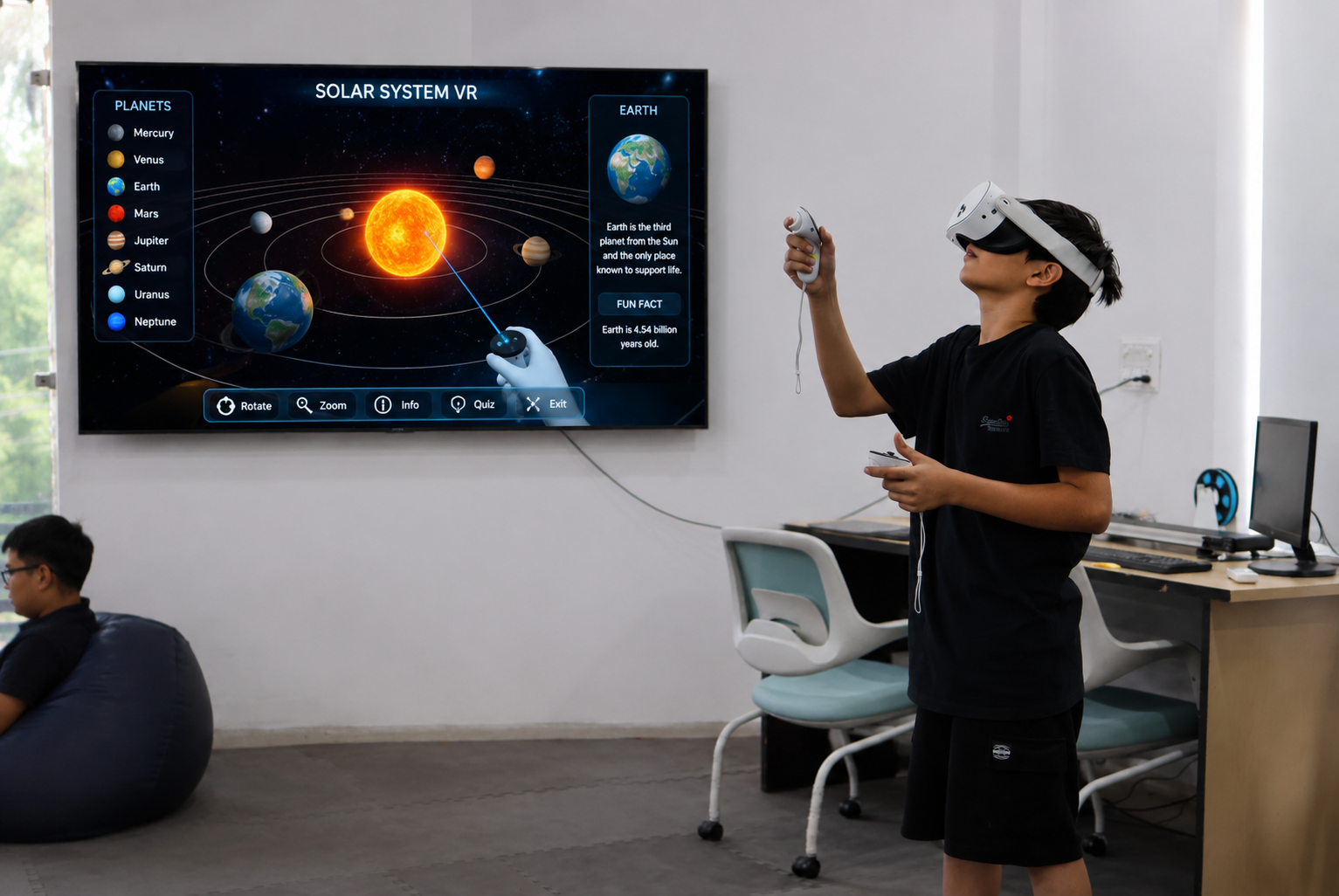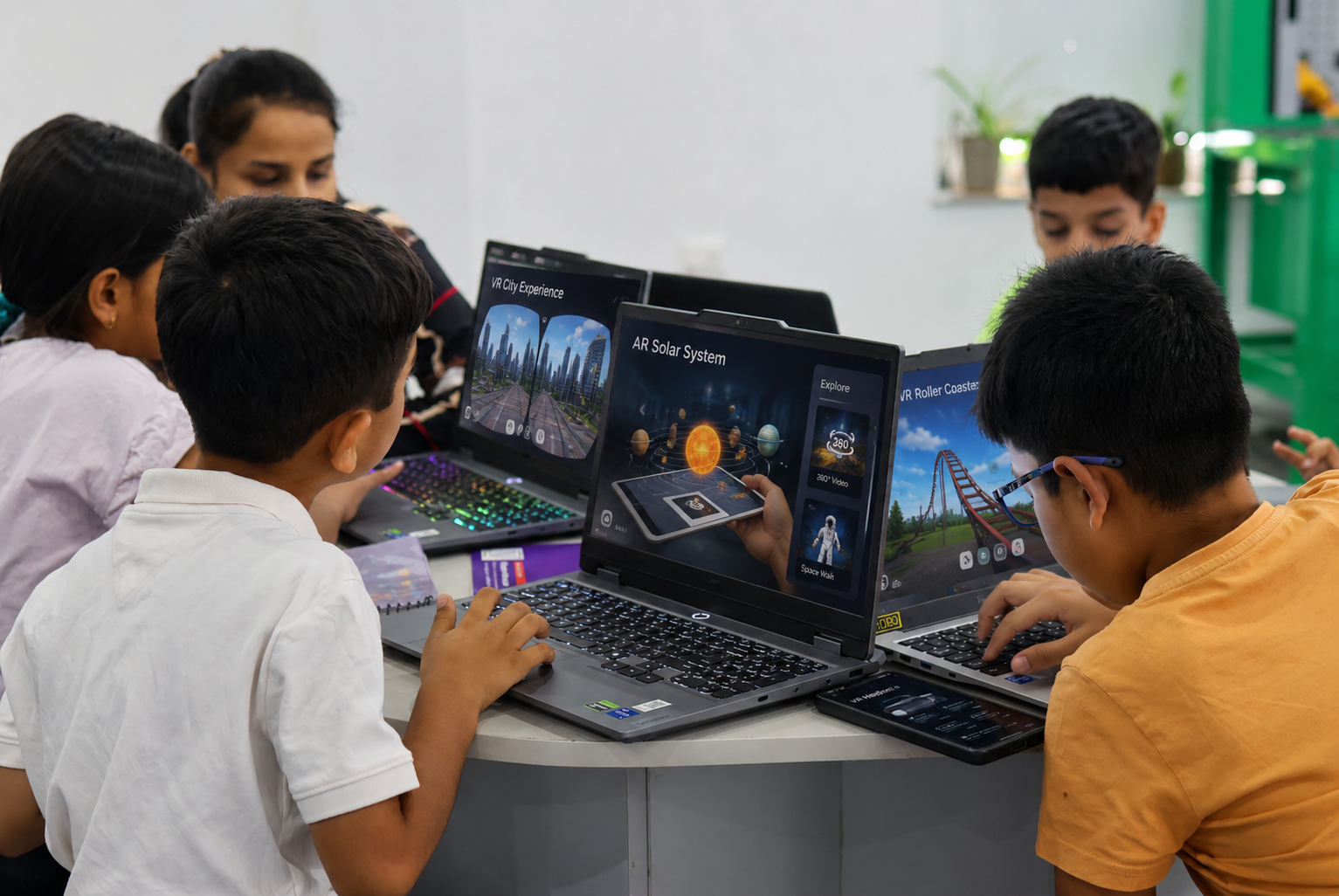
AR/VR Classes in Gurugram: What Your Child Builds, Learns, and Becomes

By MittyVerse  |  STEAM Education  |  Gurugram

Published on June 9, 2026
10 min read

Your child has watched videos inside a headset, played games with augmented overlays, and probably used filters on Instagram that track facial movement in real time. What they have not done yet is build any of it.

AR and VR are not entertainment technologies. They are engineering platforms. The companies building the next generation of these systems need people who understand 3D spatial design, interactive programming, and immersive experience development. Those people are still in short supply, and most of them are going to come from the generation that is 12 to 17 right now.

This guide is for parents in Gurugram who want to understand what AR/VR classes actually cover, what age makes sense to start, what a good program teaches versus what a surface-level one skips, and why MittyVerse is where serious students in Gurugram are doing this work.


AR and VR Are Not the Same Thing — and Your Child Will Learn Both

This distinction matters before anything else, because a lot of programs blur the two together and teach neither properly.

Augmented Reality (AR) places digital content on top of the real world. The 3D furniture preview in a shopping app, the navigation arrows that appear over a road in Google Maps, the measurement tools in your phone's camera — all AR. The content is digital, the environment is real.

Virtual Reality (VR) replaces the real world entirely with a digital one. A flight simulator, an architectural walkthrough before a building is constructed, a surgical training system — all VR. The entire environment is built.

The skills that underlie both are the same: 3D design, spatial logic, physics simulation, interaction design, and programming. A student who learns these skills properly can work in either domain. More importantly, they can work in the growing middle ground — Mixed Reality (MR) — where digital and physical elements interact with each other in real time. That is where the industry is heading, and it is where the most interesting problems are.

Difference between augmented reality AR and virtual reality VR explained for kids
AR adds to your world. VR replaces it. Students at MittyVerse learn both.

What AR/VR Classes in Gurugram Actually Teach — The Three Tracks

At MittyVerse, the AR/VR and Gaming program is structured around three tracks. Each one builds on the previous, and together they produce a student who can design, build, and ship an immersive experience from scratch.

3D and Spatial Design: This is the foundation. Students work with Blender and professional asset pipeline tools to build 3D objects, environments, and characters. They learn how digital objects exist in three-dimensional space, how lighting and texturing affect realism, and how to design for interactive use rather than just static viewing. This is the difference between a student who can draw something in 3D and one who can build something people can move through.

WebXR Systems: This is where the experiences become accessible. Using A-Frame, WebXR APIs, and Three.js, students build AR and VR experiences that run directly in a web browser — no headset required for the viewer. This is a critical skill. The ability to deploy an immersive experience without proprietary hardware dramatically expands the real-world applications. Students build environments, interactive objects, and multi-element scenes that work on any device.

Game Systems and Simulation: The most technically demanding track. Students work with Godot to build interactive systems with physics, logic scripting, and event-driven behaviour. This is where AR/VR meets engineering thinking — every interaction needs a rule, every object needs a behaviour, every scene needs a logic system that handles what happens when the user does something unexpected. Students who complete this track understand how interactive software actually works, not just how it looks.

A student who completes all three tracks can design a 3D environment, make it interactive, deploy it as a web experience, and programme the logic that governs how users move through it. That is a complete creative and technical skillset.


What Age Is Right for AR/VR Classes in Gurugram?

MittyVerse recommends ages 12 and above for the AR/VR and Gaming program. That recommendation is grounded in what the curriculum demands.

The 3D design track requires spatial reasoning and comfort with three-dimensional thinking. Most 12-year-olds have developed this sufficiently. The WebXR track requires basic programming logic — if a student has done any coding before, they have the groundwork. The game systems track involves logic scripting and event-driven programming that works best with students who can think in sequences and debug systematically.

Students aged 12 to 14 typically start with 3D design and move into WebXR over the first few months. Students aged 15 and above with prior coding or design exposure can often move faster through the foundations and spend more of their time on game systems and original project development.

One thing worth noting: AR/VR is one of the few STEAM disciplines where creative students who are not naturally drawn to traditional coding often find their entry point. The visual and spatial nature of 3D design appeals to students who think in images and environments. If your child is creative but has not connected with text-based programming, AR/VR is worth trying specifically because of that.


The AR/VR Industry in India — Why This Skill Set Matters Right Now

India's AR and VR market is growing at a compound annual rate of over 38 percent and is expected to cross USD 6 billion by 2027, according to industry research. The education, healthcare, retail, architecture, defence, and entertainment sectors are all investing heavily in immersive technology development.

The shortage of people who can actually build AR/VR experiences — not just use them — is significant. Most companies working in this space can find people who understand the concept. They cannot easily find people who can design 3D assets, write spatial interaction logic, and deploy an experience that runs reliably across devices. That specific combination of skills is what a serious AR/VR program produces.

Gurugram is particularly relevant here. The city is home to major technology companies, gaming studios, EdTech firms, and enterprise software providers — many of whom are actively building AR/VR applications. A student who develops this skillset at 14 and is ready to intern or contribute by 17 has an advantage that most engineering graduates do not have because those graduates rarely have hands-on build experience in this specific domain.

The Summer Camp data makes this concrete. MittyVerse's AR/VR Summer Camp track is one of the most enrolled programs in their 2026 lineup, which reflects genuine student interest rather than parent-driven enrollment. Students who have tried it are asking to continue. That is the clearest signal of whether a program is actually engaging.

AR VR career opportunities India market growth 2027
India's AR/VR market is projected to cross USD 6 billion by 2027

What MittyVerse's AR/VR Program Looks Like in Practice

MittyVerse runs their AR/VR and Gaming program from their makerspace in Sector 85, Gurugram. The program is available both online and offline, runs at 4 hours per week, and is designed for students aged 12 and above.

The curriculum moves through the three tracks described above, but the pace is determined by demonstrated competence rather than a fixed calendar. A student who moves quickly through 3D design does not wait for a scheduled module change. They move into WebXR when they are ready. This matters in a creative technical discipline where the distance between students at the same age can be significant.

Batch sizes are kept between 12 and 15 students. In an AR/VR program, this is particularly important because individual project work is the core of the learning. A student building an interactive 3D environment needs feedback on their specific design decisions, not general instruction. Small batches make that possible.

Students who complete the program leave with three things: a MittyVerse certification, a portfolio of built projects (at minimum a 3D environment, a WebXR experience, and an interactive simulation), and the technical foundation to continue building independently. That last point is the one that separates a good program from one that creates dependency on structured instruction.

Full curriculum details are on the MittyVerse AR/VR and Gaming program page.
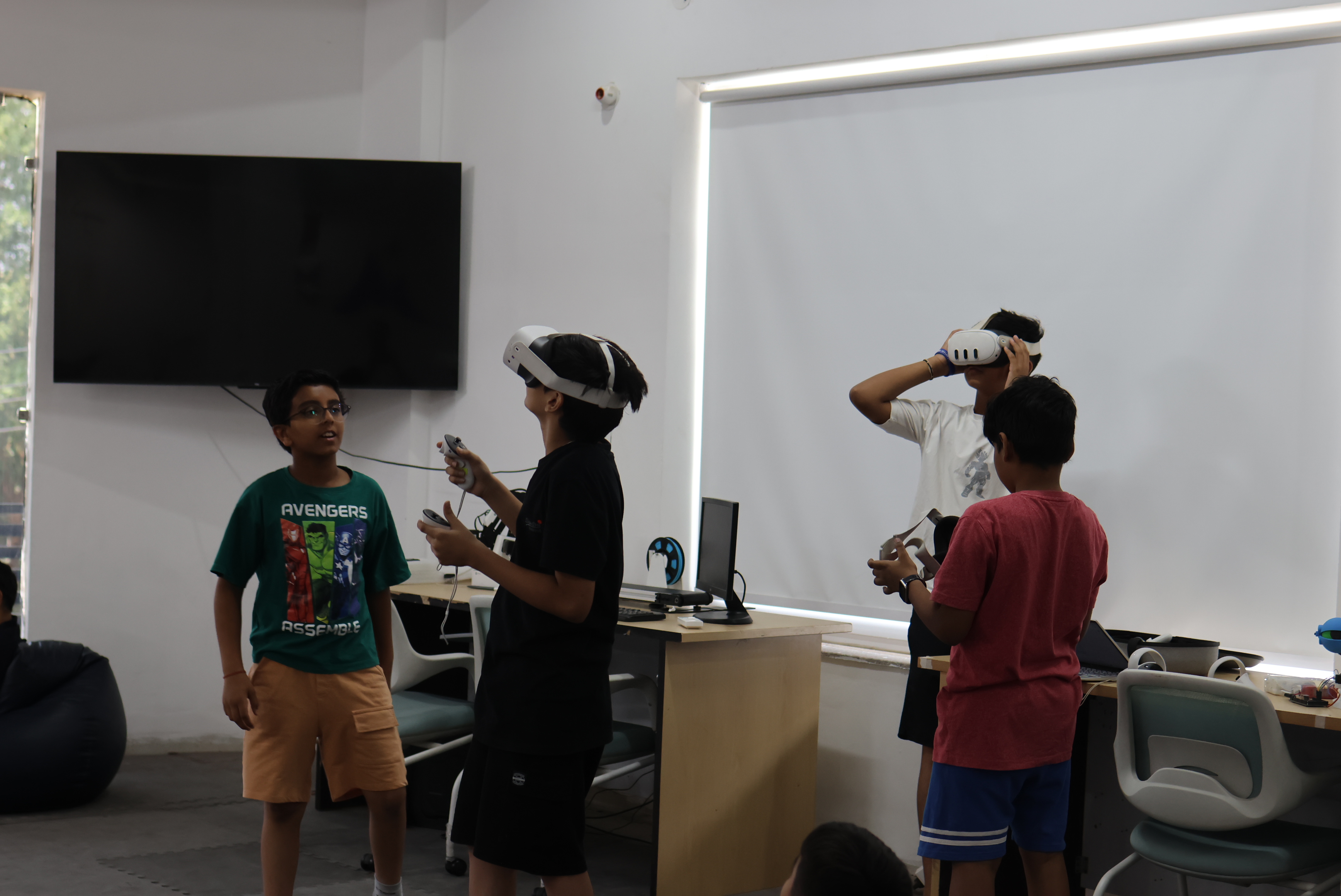
MittyVerse AR VR and gaming program lab session Gurugram Sector 85
AR/VR sessions at MittyVerse Makerspace, Sector 85, Gurugram

Five Questions to Ask Any AR/VR Program Before Enrolling

Not every program that uses the words AR and VR in its name teaches either seriously. These five questions will tell you within five minutes whether a program is worth your time and money.

What software do students actually work with? The correct answers are Blender, A-Frame, Three.js, WebXR APIs, and Godot (or Unity for advanced game development). Vague answers like 'industry-standard tools' without naming them are a red flag.

What does a student's portfolio look like after completing the course? They should be able to show you a 3D-designed environment, a deployable WebXR experience, and an interactive simulation with logic scripting. A certificate alone is not a portfolio.

Is there real build time in every session, or mostly instruction? AR/VR cannot be learned by watching. Every session should include hands-on project work. If more than 30 percent of any session is passive instruction, the program is structured wrong.

Can students deploy their work publicly? A WebXR experience built in A-Frame and Three.js can be deployed to any web server and viewed on any device. Students should be doing this, not just running projects on a local machine. If the program does not get to deployment, it is stopping before the most important step.

Does the program distinguish between AR and VR development? They require different design thinking. AR is about placing digital content in real space. VR is about designing entire environments from scratch. A program that treats them as the same thing is missing half the picture.


AR/VR Summer Camp in Gurugram — Start Here If You Are Not Sure

MittyVerse's AR/VR Summer Camp 2026 is the lowest-commitment way to find out whether this field interests your child. It runs in weekly batches through June — 25-29 May, 1-5 Jun, 8-12 Jun, 15-19 Jun, and 22-26 Jun — for students aged 13 and above, from 2:30 PM to 4:30 PM.

The camp covers 3D design, basic interaction design, and an introduction to immersive storytelling over five days. Students leave having built something they can show. The question of whether to continue into a full program usually answers itself after day three.

One week. Two hours a day. Real output. That is the right way to test whether this is a direction worth pursuing before committing to a term-length program.


Your Child Is Already Consuming AR and VR. They Could Be Building It.

The gap between using technology and understanding how to build it is not as large as it seems at 12 or 14. It requires structured learning, good instructors, and enough hands-on time to develop real fluency. All three of those things are available in Gurugram right now.

The students who start building AR/VR experiences at 13 are going to be the ones designing them professionally at 23. That window does not stay open indefinitely, and the students who start now have a genuine advantage over those who wait.

If you want to see what this learning looks like in practice, book a free demo class at MittyVerse. No commitment — just 45 minutes to see the teaching style and let your child experience it firsthand.


Frequently Asked Questions About AR/VR Classes in Gurugram

AR/VR classes teach students to build augmented and virtual reality experiences. A structured program covers three areas: 3D and spatial design (Blender, asset pipelines), WebXR development (A-Frame, Three.js, WebXR APIs), and game systems and simulation (Godot, physics scripting, event logic). Students learn to design, programme, and deploy immersive digital experiences.
Augmented Reality (AR) overlays digital content onto the real world — like navigation arrows on a road or 3D furniture in a room preview. Virtual Reality (VR) replaces the real world entirely with a digital environment — like a flight simulator or architectural walkthrough. Both require 3D design and programming skills, but different design thinking. A good program teaches both.
MittyVerse's AR/VR and Gaming program is recommended for ages 12 and above. Students aged 12 to 14 typically start with 3D design and progress into WebXR development. Students aged 15 and above with prior coding or design experience can move into game systems and advanced project work more quickly.
At MittyVerse, AR/VR and Gaming is a Professional Program with 16 hours of monthly sessions. The Innovator Program, which provides access to professional programs including AR/VR, is priced at Rs. 6,999 per month. A free demo class is available before any enrollment commitment.
Students at MittyVerse work with Blender for 3D design and asset creation, A-Frame and Three.js for WebXR experience development, WebXR APIs for browser-based AR/VR deployment, and Godot for game systems, physics simulation, and interactive logic scripting. These are industry-used tools, not simplified educational versions.
Yes. MittyVerse runs an AR/VR Summer Camp 2026 in Gurugram for students aged 13 and above. Batches run weekly through June: 25-29 May, 1-5 Jun, 8-12 Jun, 15-19 Jun, 22-26 Jun. Sessions run 2:30 PM to 4:30 PM. The camp covers 3D design, interaction design, and immersive storytelling over five days.
India's AR/VR market is projected to cross USD 6 billion by 2027. Career paths include XR developer, 3D environment designer, immersive experience designer, game developer, VR simulation engineer, AR application developer, and spatial computing specialist. Industries hiring include education, healthcare, architecture, retail, defence, gaming, and enterprise software.
Yes. MittyVerse offers the AR/VR and Gaming program both online and offline. The 3D design and WebXR development tracks are well-suited to online learning with the right setup. Offline sessions at the Sector 85 Gurugram makerspace provide additional access to equipment and real-time instructor feedback on physical interactions.

Book a free demo with MittyVerse

AR/VR classes in Gurugram — ages 12 and above. 45 minutes, completely free. No commitment.  |  📞 +91 99532 19191