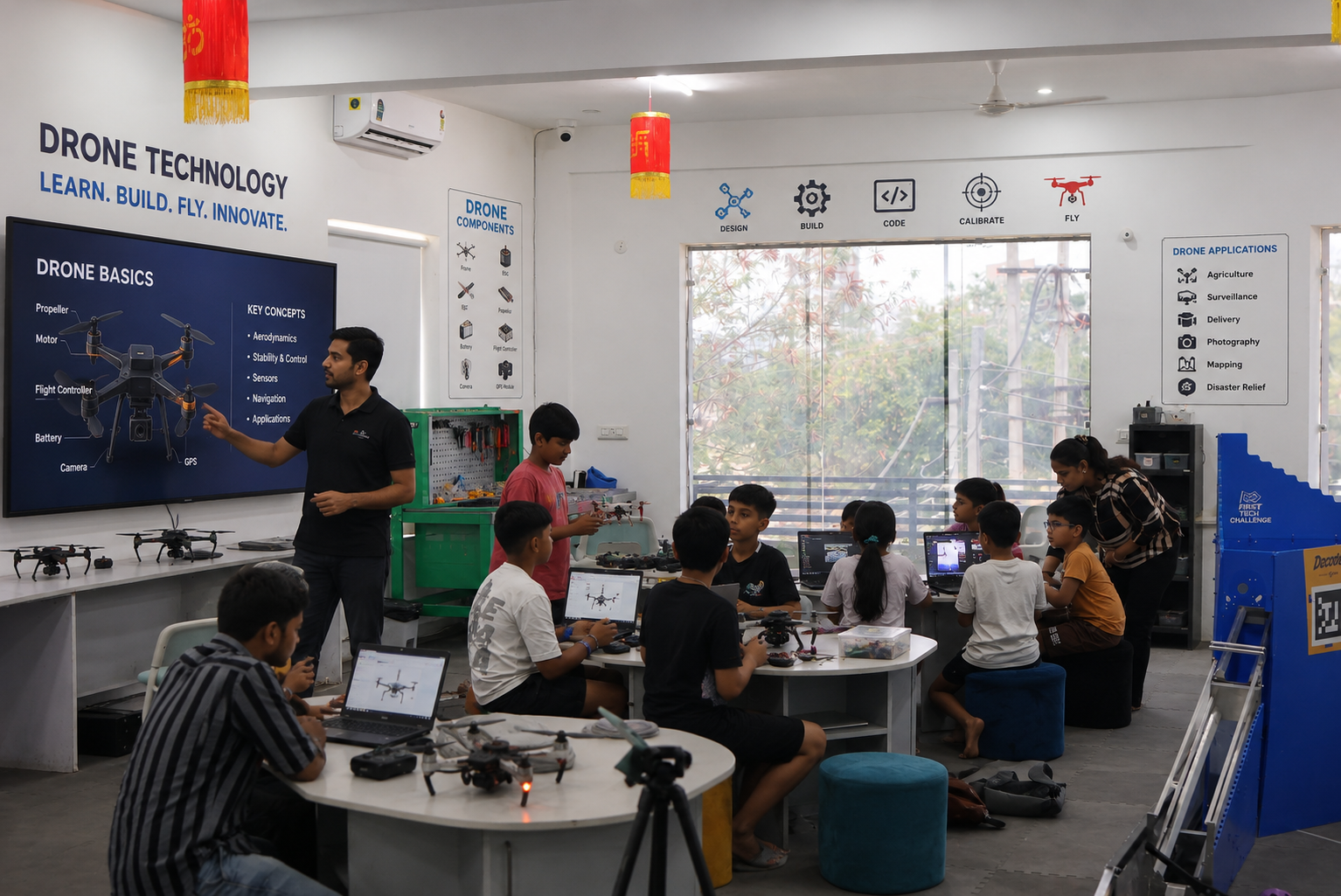
Most parents hear 'drone classes' and picture a kid flying a toy around a park. What actually happens inside a serious drone program is something entirely different.
Your child will learn why a drone stays in the air, how flight controllers read sensors a hundred times per second, how to program a drone to navigate on its own, and how the same technology is used today in agriculture, filmmaking, disaster rescue, and defence. This is not a hobby course. It is an engineering education disguised as something that looks like fun.
If you are a parent in Gurugram trying to figure out whether drone classes are worth it what your child will learn, whether it is safe, what age makes sense, and what to expect from a good program this guide answers all of it directly.
What Drone Classes for Kids in Gurugram Actually Cover
The word 'drone class' means very different things at different places. Some programs hand a kid a controller and call it a day. A real program covers three distinct areas, and a child who completes all three comes out with actual engineering knowledge.
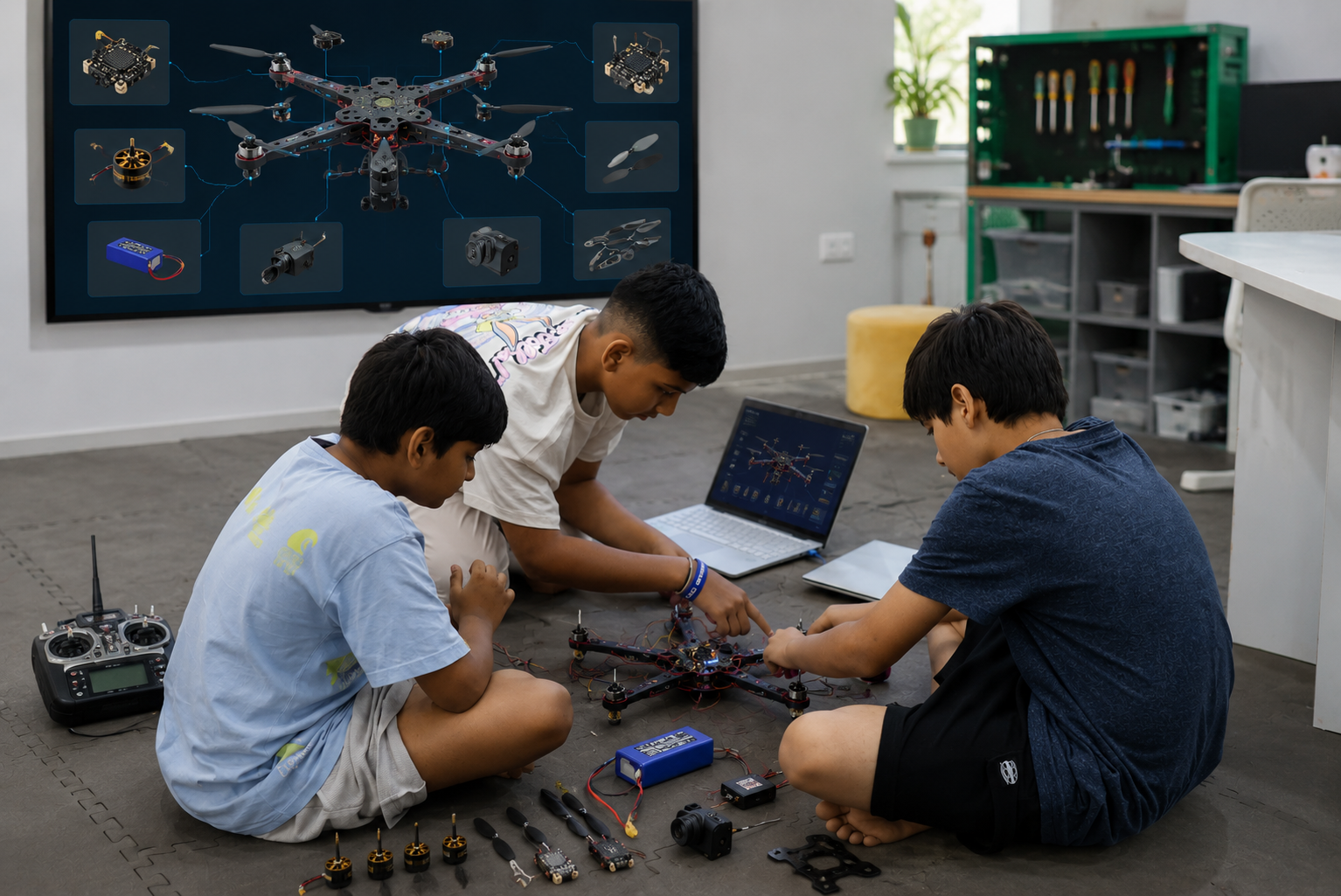
Drone Fundamentals: This is where everything starts. Students learn the physics of flight lift, thrust, drag, and stability. They study the parts that make a drone work: flight controllers, Electronic Speed Controllers (ESCs), propellers, and IMU sensors. This is not optional background knowledge. A student who does not understand why a drone behaves the way it does cannot fix it when something goes wrong, and things do go wrong.
Drone Programming: This is where it gets genuinely interesting. Using tools like CoDrone and Python-based control systems, students write code that tells a drone exactly what to do. Turn left at a specific angle. Ascend three metres. Hold position. Every instruction has to be precise, and the drone either follows it or it does not. This teaches logical thinking in a way that no textbook exercise can match.
Autonomous Systems: The advanced level. Students work with ArduPilot and mission planning tools to build drones that operate without a human holding the controller. They explore swarm coordination, where multiple drones work together on a single task. This is the technology behind delivery drones, agricultural sprayers, and search-and-rescue systems operating right now in the real world.
A student who goes through all three tracks can explain how a drone works, program its behaviour, and design a mission for it to fly independently. That is a very different outcome from learning to fly one.
Is Drone Training Safe for Kids? Here Is the Honest Answer
This is the question most parents want answered first but hesitate to ask directly. So here it is directly: yes, drone training is safe for kids when the program is structured properly.
Consumer drones used in educational settings are small, lightweight, and fitted with blade guards. The drones used for beginner and intermediate students are not the heavy commercial units you see in news footage. A typical training drone weighs between 100 and 300 grams. At that size, a malfunction means a crash landing, not a safety incident.
The more important safety element is supervision and protocol. Every flight session at a serious program has a trained instructor present. Beginners fly in simulators before they touch a real drone. Students learn pre-flight checklists, no-fly zone rules, and safe operating distances before any real hardware is in their hands. These are the same habits professional pilots build. Teaching them at 14 means they are ingrained by 18.
India's DGCA (Directorate General of Civil Aviation) has published drone regulations under the Drone Rules 2021. A good program introduces students to these rules as part of the curriculum. Students leave knowing not just how to fly, but how to fly legally and responsibly.
What Age Is Right for Drone Classes in Gurugram?
MittyVerse recommends ages 13 and above for their Drone Technology program. That recommendation is based on the cognitive demands of the curriculum, not arbitrary rules.
The programming component requires students to think sequentially and debug code. The autonomous systems module requires understanding sensors, coordinate systems, and mission logic. A 10-year-old can understand the basics of flight. A 13-year-old can programme the flight.
That said, younger students between 10 and 12 who have already done foundational coding or robotics can handle the fundamentals section well. If your child has been through a coding or robotics program already, they have the logical groundwork to start earlier than 13. Worth discussing directly with the program before enrolling.
For students aged 15 and above with prior STEAM exposure, the advanced autonomous systems track is accessible from the start. These students can move through fundamentals quickly and spend most of their time on programming and mission design, which is where the real depth is.
Why Drone Technology Is a Serious Career Skill, Not Just a Hobby
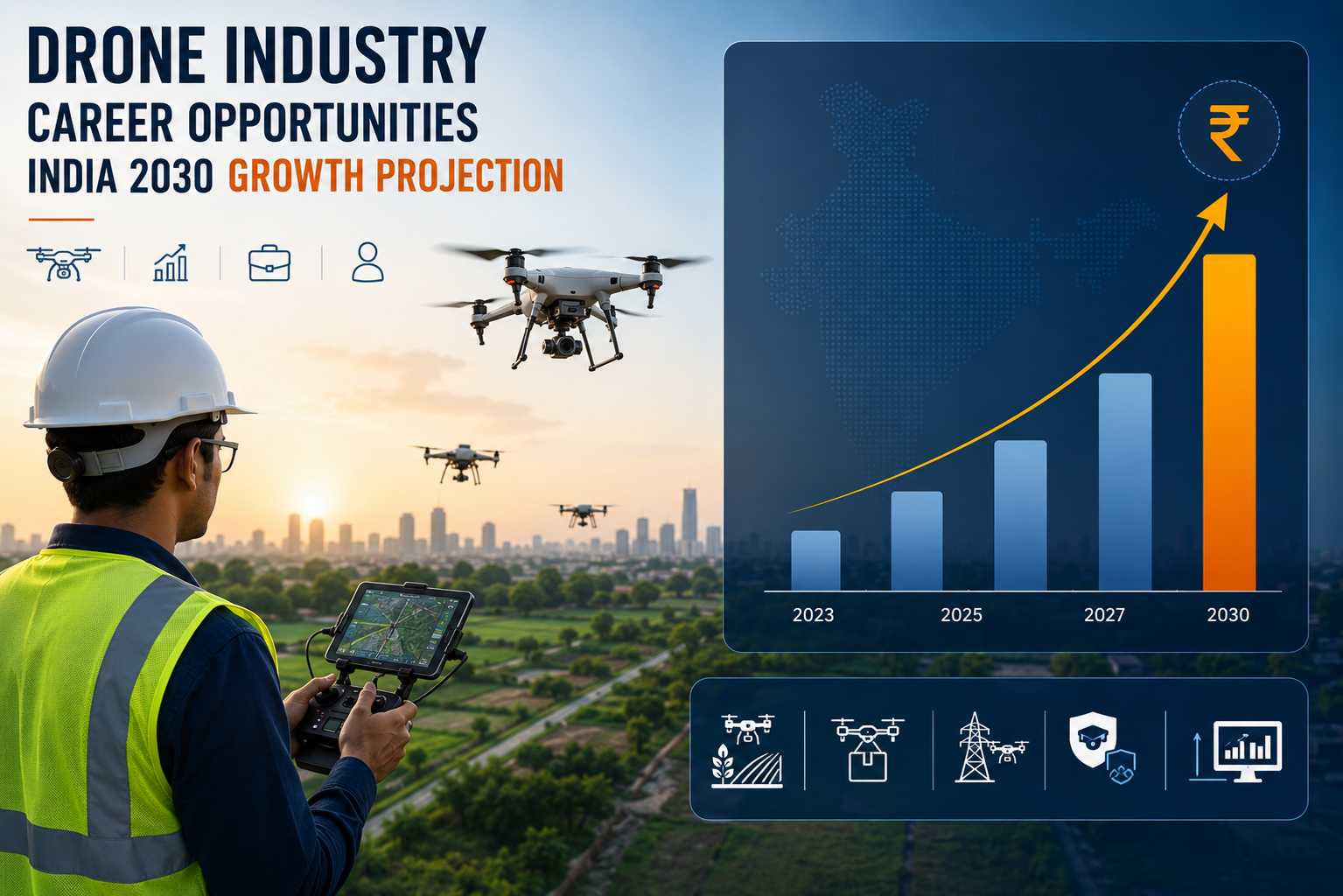
India's drone industry was valued at approximately Rs. 12,000 crore in 2023 and is projected to grow to Rs. 1,50,000 crore by 2030, according to the Ministry of Civil Aviation's drone policy roadmap. The government's Production Linked Incentive scheme for drones has already attracted major manufacturers to set up operations in India.
The skills required to work in this industry are exactly what a structured drone program teaches: aerodynamics, sensor systems, programming, autonomous navigation, and mission planning. Companies hiring in this space are not looking for people who can fly a drone with a controller. They are looking for people who can build systems, write code, and design missions.
Beyond dedicated drone companies, the applications extend across agriculture (precision spraying, crop monitoring), infrastructure (bridge and pipeline inspection), logistics (last-mile delivery), filmmaking, and public safety. A student who understands drone technology at 16 has entry points into multiple high-growth industries at 22.
This is also one of the few technology areas where India has a genuine first-mover opportunity. The regulatory framework is still forming, the industry is still building, and the people with deep technical knowledge are still relatively few. That gap does not stay open forever.
What the MittyVerse Drone Technology Program Looks Like in Practice
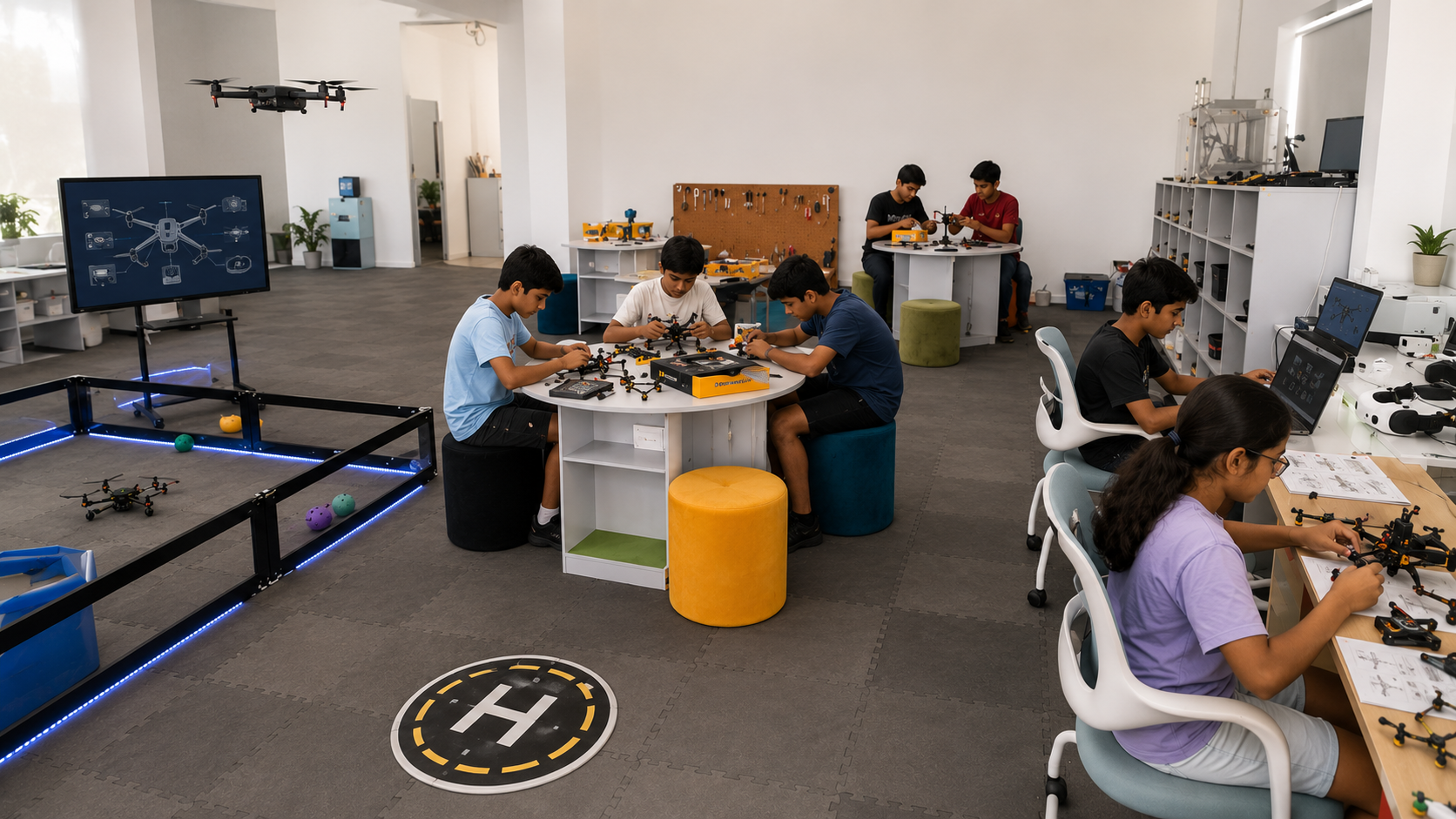
MittyVerse runs their Drone Technology program from their makerspace in Sector 85, Gurugram. It is available both online and offline, runs at 4 hours per week, and is designed for students aged 13 and above.
The curriculum follows the three-track structure described above. Fundamentals first, then programming with CoDrone and Python, then autonomous systems with ArduPilot and mission planning tools. The pace is not fixed students move through each track based on demonstrated understanding, not a calendar.
Batch sizes are capped at 12 to 15 students. This matters in a drone program more than in most courses, because hands-on time with hardware is limited, and a batch of 30 means most students are watching rather than doing. At 12 to 15, every student gets real time with the equipment every session.
Students who complete the program leave with a MittyVerse certification and, more usefully, a project portfolio that includes a programmed flight sequence and an autonomous mission design. These are demonstrable outputs, not just a certificate that says they attended.
Full program details are on the MittyVerse Drone Technology page.
How to Tell If a Drone Program Is Worth Your Money
Gurugram has several places offering drone courses for kids. Most of them are not equal. Here is what separates a program worth paying for from one that is not.
They fly simulators before real drones. Any program that puts a beginner on a real drone in week one is skipping safety and skipping learning. Simulator time is not optional. It is how students build muscle memory and spatial reasoning without risk.
They teach programming, not just flying. Flying a drone with a controller is a skill that takes an afternoon to learn at a basic level. Programming one to execute a mission is a skill that takes months and teaches transferable engineering thinking. If the curriculum stops at flying, the program stops too early.
They cover regulations. DGCA drone rules, no-fly zones, registration requirements, operational limits. A student who does not know these is not prepared to use drones in any professional context. A program that skips this is cutting corners.
The instructor has real experience. Ask directly: has the instructor worked on drone systems outside of a classroom? Have they built or programmed autonomous systems? Theory without application produces instructors who can explain but not demonstrate.
Students build something real. By the end of the program, a student should have a programmed flight sequence and an autonomous mission in their portfolio. If the only output is a certificate, you have paid for attendance, not learning.
Drone Summer Camp in Gurugram: The Right Way to Start
If your child has never tried a STEAM program before, or if you want to test their interest before committing to a full course, MittyVerse's Summer Camp 2026 is the practical starting point.
The camp runs in weekly batches through June 25-29 May, 1-5 Jun, 8-12 Jun, 15-19 Jun, and 22-26 Jun. It is five days, two hours a day, and it covers the core concepts of drone technology in a hands-on format designed for first-timers.
Five days is enough time to know whether your child finds this genuinely engaging or not. That is useful information. A full-term program is a significant investment. A summer camp is not. If they come home on day three asking whether they can do it again, you have your answer.
One Last Thing Before You Decide
Drone technology is not a niche skill. It is the intersection of physics, programming, electronics, and systems thinking. A student who learns it properly is not just learning to fly. They are learning to engineer.
Gurugram is one of the best places in India to start this education right now. The industry is growing, the opportunities are forming, and the programs that teach it seriously are still accessible.
The most useful next step is a free demo class. No commitment, no sales pitch just 45 minutes to see how MittyVerse teaches and whether it clicks for your child. Book a free demo here.