Every device your child touches today was built by someone who assumed it would eventually be attacked. Most parents never think about that. Most kids definitely do not.
Cybersecurity classes for kids in Gurugram exist to close exactly that gap not by scaring children about the internet, but by teaching them how digital systems actually get broken into, and how to stop it. This is one of the least understood STEAM disciplines among parents, mostly because the word "hacking" carries baggage it does not deserve in an educational context.
This guide covers what a real cybersecurity program teaches, whether it is appropriate for children, what age makes sense, and what MittyVerse offers in Gurugram.
Wait, Are We Teaching Kids to Hack?
Yes, and that is exactly the point with a crucial distinction most parents miss on first hearing this.
Ethical hacking is a formal, recognised discipline. Every major technology company banks, hospitals, government systems employs people whose entire job is to break into their own systems before an actual criminal does. This is called penetration testing, and it is one of the most in-demand, well-paid roles in technology today.
Teaching a 13-year-old ethical hacking does not mean teaching them to commit crimes. It means teaching them adversarial thinking: how does an attacker think, what does a vulnerability look like, and how do you close it before someone with bad intentions finds it first. Every serious program pairs this with a strong ethics framework from day one students learn what responsible disclosure means and why unauthorised access is illegal, alongside the technical skill.
A student who understands how systems get attacked is a student who knows how to defend them. That is the entire premise of the field.
What Cybersecurity Classes for Kids Actually Cover
A program that only teaches "internet safety" strong passwords, don't click suspicious links is not a cybersecurity education. That is a single afternoon of content stretched into a full course. A real program covers three distinct, technical areas.
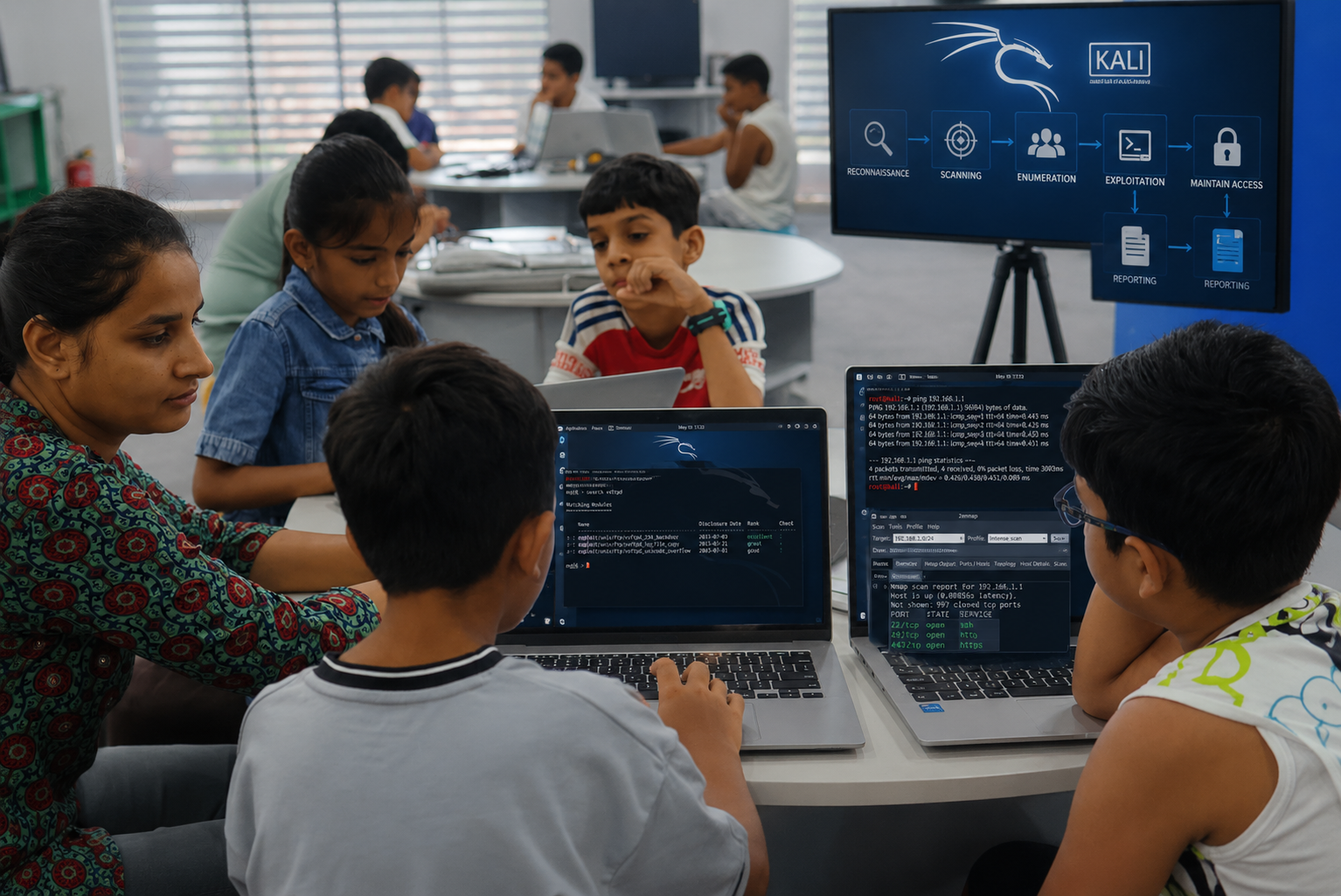
Ethical Hacking and Penetration Testing. Students work with real industry tools Kali Linux, Nmap, Wireshark, and Metasploit to learn how systems are attacked and how vulnerabilities are identified. This is adversarial, problem-based learning. Students are given a system, told to find its weaknesses, and then taught why those weaknesses existed in the first place.
Security Frameworks and Protocols. This is the defensive half of the equation. Students learn the OWASP Top 10, the industry-standard list of the most critical web application security risks, along with encryption basics and how authentication systems work. This is where students move from "breaking things" to "designing things that cannot be broken."
Digital Forensics and Fingerprinting. The investigative track. Students learn to read network logs, analyse data packets, and use OSINT (Open Source Intelligence) tools to trace and investigate digital activity. This is the same skillset used by professionals who reconstruct what happened after a breach which system was touched first, how the attacker moved, what they took.
A student who completes all three tracks does not just know how to be careful online. They understand how modern digital infrastructure is attacked, defended, and investigated end to end.
What Age Is Right for Cybersecurity Classes in Gurugram?
MittyVerse recommends ages 13 and above for the Cybersecurity program, and that recommendation is not arbitrary.
Penetration testing tools like Nmap and Metasploit require comfort with command-line interfaces and networking fundamentals. Understanding the OWASP Top 10 requires some prior exposure to how web applications are built. Digital forensics requires the kind of methodical, investigative patience that develops more reliably in early teenagers than in younger children.
Students who have already been through a coding or robotics program have the logical groundwork that makes this transition smoother. A 13-year-old who has spent a year writing Python has a real head start over one starting from zero. If your child has no prior technical background, starting with the Coding or AI & ML program first and moving into Cybersecurity a year later is a reasonable, common path.
Why This Skill Is Urgent Right Now in India
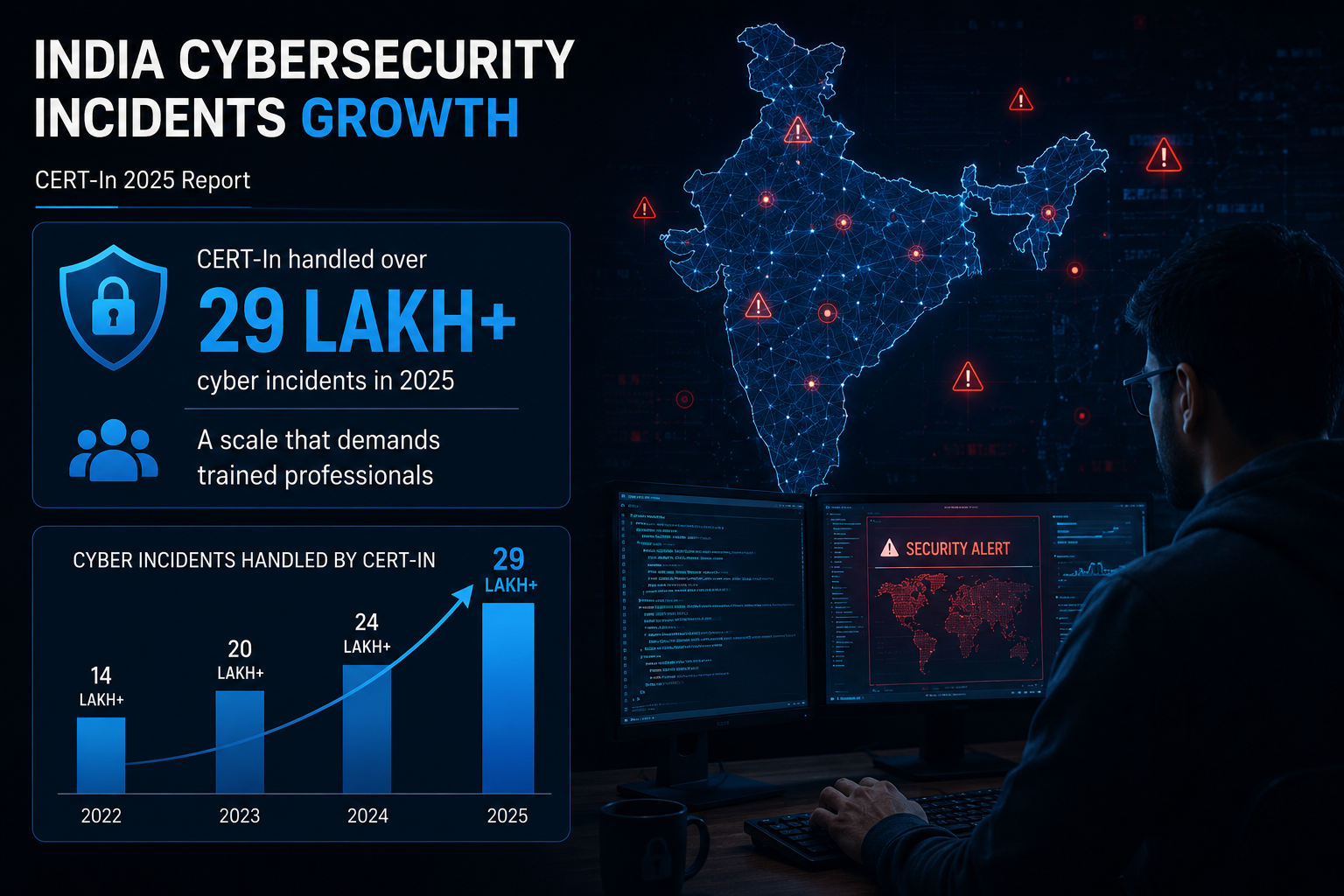
This is not a hypothetical future problem. India's Computer Emergency Response Team (CERT-In) reported handling more than 29.44 lakh cyber incidents in 2025, according to a government statement a sharp jump from the previous year. That is the scale of the problem the next generation of security professionals is walking into.
The demand for people who can actually address this is not being met. Multiple industry workforce studies point to a severe shortfall of trained cybersecurity professionals in India relative to the number of open roles, a gap that has persisted for several years and shows no sign of closing quickly. Companies are not short on interest they are short on people who have hands-on, practical training rather than theoretical certification alone.
Gurugram specifically sits inside this problem. The city hosts a dense concentration of financial services firms, SaaS companies, and enterprise technology offices all of which need security talent locally. A student who builds real cybersecurity skills at 13 is positioned for internships, bug bounty programs, and entry-level security roles years before most of their peers have written a single line of security-focused code.
What the MittyVerse Cybersecurity Program Looks Like in Practice
MittyVerse runs the Cybersecurity program from its makerspace in Sector 85, Gurugram, available both online and offline, with 4 hours of sessions per week for students aged 13 and above.
The program moves through the three tracks covered above ethical hacking, security frameworks, and digital forensics with a teaching approach built around problem-based and investigative learning rather than lectures. Students are handed a scenario and work through it, the same way a junior security analyst would on their first job.
Batch sizes stay at 12 to 15 students, which matters more in cybersecurity than in most disciplines a student working through a penetration testing exercise needs an instructor who can see exactly where they are stuck, not a room where thirty students are sharing one screen.
Full curriculum details are on the MittyVerse Cybersecurity program page.
How to Evaluate Any Cybersecurity Program Before You Enrol
Gurugram has a growing number of programs using the word "cybersecurity" loosely. Here is how to tell a serious one from a marketing label.
- Do they teach real tools, or a simulation of them? Kali Linux, Nmap, Wireshark, and Metasploit are the actual tools used in the industry. A program using made-up, simplified software is teaching a watered-down version of the field.
- Is there an explicit ethics component? Any program teaching offensive security skills without a clear, upfront framework on legality and responsible disclosure is doing it wrong. This should not be an afterthought.
- Does it go beyond "internet safety"? Password hygiene and phishing awareness are useful for a 9-year-old. They are not a cybersecurity curriculum for a 13-year-old ready for technical depth.
- Can the instructor demonstrate real experience? Ask directly whether the instructor has worked on actual security systems, not just taught the syllabus.
- Is there a free demo before you commit? A program confident in its teaching will let you and your child see a session before any payment changes hands.
Frequently Asked Questions About Cybersecurity Classes for Kids in Gurugram
The Right Time to Start Is Before They Need It
Every system your child will use as an adult banking apps, hospital records, the company they eventually work for depends on people who understand how to defend it. That understanding does not arrive automatically at 22 with a computer science degree. It is built, deliberately, starting years earlier.
Gurugram's students have real access to this education right now, taught by people who treat it as the serious technical discipline it is, not a buzzword.
If you want to see what that looks like in person, the first step is simple. Book a free demo class at MittyVerse. No commitment just 45 minutes to see how the teaching works and whether it is the right fit for your child.